
Dumbleton Hall reopens as a 34-room Cotswolds hotel after two years
Its restaurant, Cedar 1905, carries Flaming June and Roman columns, and the interiors borrow from Morris & Co and Watts 1874.

Dumbleton Hall, a Grade II* manor house in the Cotswolds, has reopened as a hotel after a two-year restoration. The multi-million-pound project was carried out to return the building, first constructed in 1830, to what the owners call its former glory.
The result is 34 individually designed bedrooms and suites, alongside a restaurant named Cedar 1905. Interiors draw the refinement of the Belle Époque together with the glamour of the Roaring Twenties, in what the owners describe as a distinctly English house.
The house has serious literary pedigree. Once a celebrated salon of intellect and creativity, Dumbleton Hall welcomed Charles Dickens, Charles Darwin and Elizabeth Gaskell. Under the Eyres-Monsell family it later hosted the Mitford sisters, John Betjeman and Patrick Leigh Fermor.
Original features were carefully restored throughout, including high ceilings with Neoclassical cornicing and Arts & Crafts detailing, and large sash windows looking over the estate. The restoration has been framed as a layering of heritage rather than a stripping back.
The entrance nods to the Victorian fascination with exoticism, a tribute to the Eyres-Monsell family's travels. It carries Cole & Son's Boscobel Oak wallpaper with gilded lions, black lacquer coffee tables in a Chinese style, blue-and-white porcelain, a Persian wool rug and Kentia palms.
The grand staircase walls are painted in Oval Room Blue, a darkened historic blue framed by white cornicing, and a Victorian-style skylight floods them with light. Colourful animal heads by Carola van Dyke reimagine the taxidermy heads visible in archive photographs of the house.
A history wall at the top of the staircase gathers black-and-white archive photographs, while the grand entrance holds portraits of figures connected to Dumbleton Hall. The house leans deliberately on its past, and the owners say the layered result is both timeless and distinctly English.
The Drawing Room, Library Bar and Pheasant Lounge remain the social heart of the property. Centred on original log-burning fireplaces, these rooms are designed for lingering conversation, afternoon tea and evening cocktails, with rich velvets, atmospheric lighting, opulent hues and restored antiques.
Morris & Co and Watts 1874 fabrics
Morris & Co prints run through the interiors in honour of William Morris and his Cotswolds ties. Fabrics draw on The Huntington, a collection of his previously unfinished sketches, and Strawberry Thief, which he designed at Kelmscott House after watching birds steal strawberries from the garden.
Watts 1874 damask appears as upholstery on cushions across the property. In Cedar 1905, a Watts fabric called Rialto in Tiffany Teal was paperbacked into wallpaper for the panelling, introducing an eighteenth-century damask of scrolling foliage and florals.
That is the same damask Harry Styles wore on his recent tour, in a collaboration between JW Anderson and Watts 1874 that has ushered in a revival of damask in design. Watts upholstery reflects a shared appreciation for British craftsmanship and heritage.
The restaurant that carries Flaming June
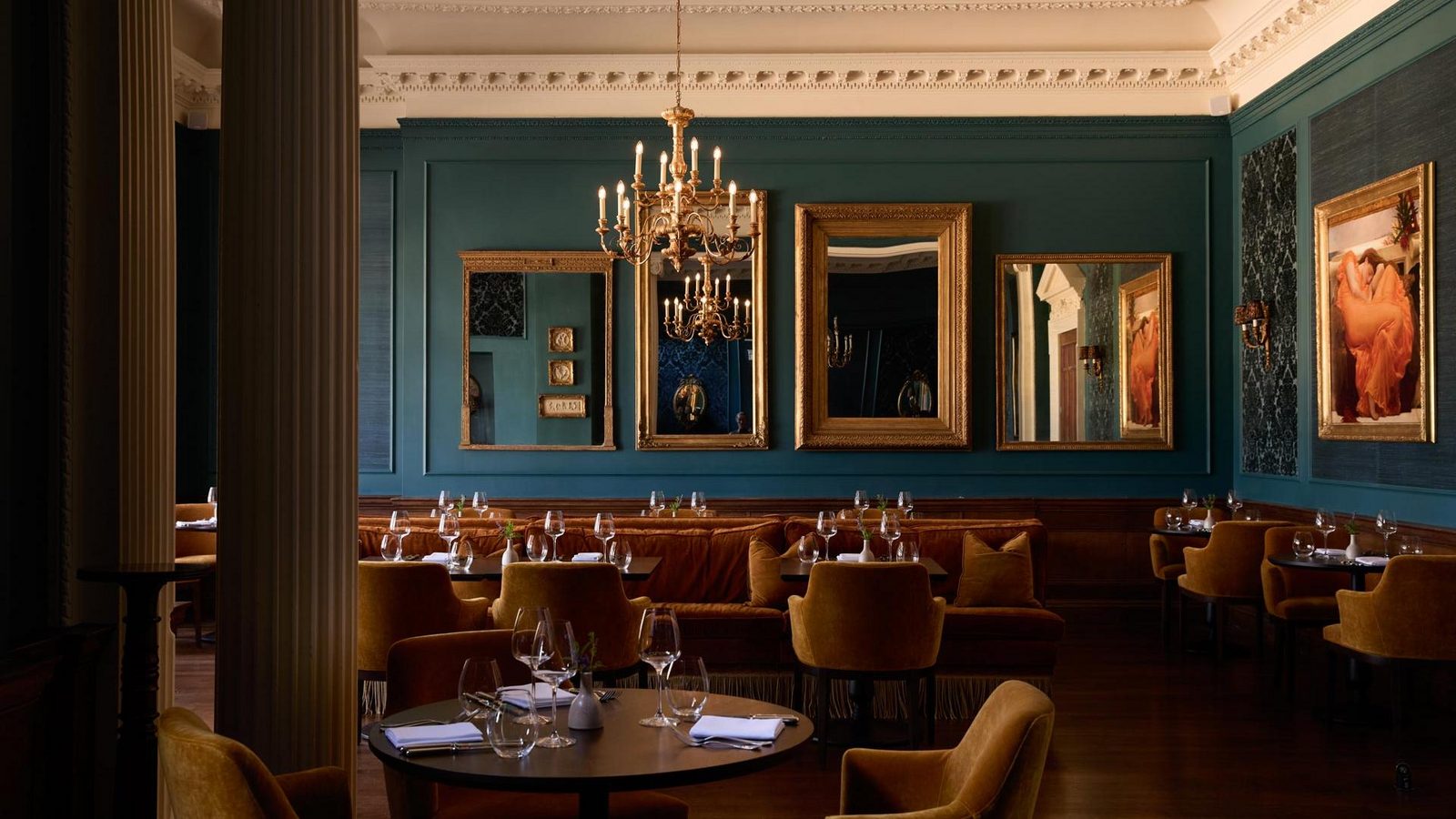
Cedar 1905 is the only space that embraces a distinctly Neoclassical aesthetic. Roman columns and elaborate plaster cornices define it, enhanced by antique gilded mirrors, large bay windows and decadent glass chandeliers that shift the room from day into night.
Fringed banquettes in Linwood Cosmos Velvet complete the theatrical setting, and the influence of the Victorian artist Frederic Leighton is felt through Flaming June, displayed in the restaurant. Photographer Scarlett Casciello's Sicilian Lemon adds a contemporary European sensibility.
The private dining nook is deliberately more decadent still, framed by navy velvet drapery at the entrance and lit by a small antique crystal chandelier. It is a room built for a single table rather than a crowd.
Bedrooms follow one of two themes, painted or papered. Painted rooms use soft greens and blues or warm earthy pinks and yellows, accented by Morris & Co patterned fabrics. Each room is designed to invite the outdoors in at every turn.
Wallpapered rooms invert the formula, balancing bold prints of flowers, fruits and foliage with more muted soft furnishings. They also carry tweed curtains and herringbone carpets in natural fibres, a nod to the celebrated Cotswolds wool industry, plus hand-painted prints of British game birds.
No room rates or ownership details have been disclosed. The owners have set the house up to feel more like an elegant private home than a traditional hotel, with the social rooms at its centre.
Support the content you love — it’s free 🎉
Add Luxa Terra as a preferred source on Google. Our stories will be more likely to appear in Google’s Top Stories. It’s free and supports our team. Thank you!
Add as preferred sourceYou can remove us any time in Google’s source preferences.
Thank you — see you in Top Stories 🎉
Luxa Terra is now one of your preferred sources on Google, so our stories are more likely to appear when you search.
Sources
This briefing is published daily using an AI-powered system crafted by Luxa Terra’s team and finely tuned to meet our editorial standards. While we continuously test and review the output, mistakes can sometimes happen. Tell us if you spot one.
Image: sleepermagazine.com


